The UAB awarded Team Impact Award 2026 by the ECIU for its AI project on radiophonic heritage
The UAB stood out for its participation in the ECIU University Forum 2026, held on 16 and 17 June at the University of Aveiro, with conferences offered by students and lecturers. It also received the Team Impact Award for its results in the challenge of using artificial intelligence in relation to radiophonic heritage. The UAB delegation, made up of 22 people including students, technical staff and lecturers, was led by Ramon Vilanova, vice-rector for Studies and Quality; Xavier Ariño, head of the Institutional Projects Office; and Mireia Galí, ECIU institutional coordinator.
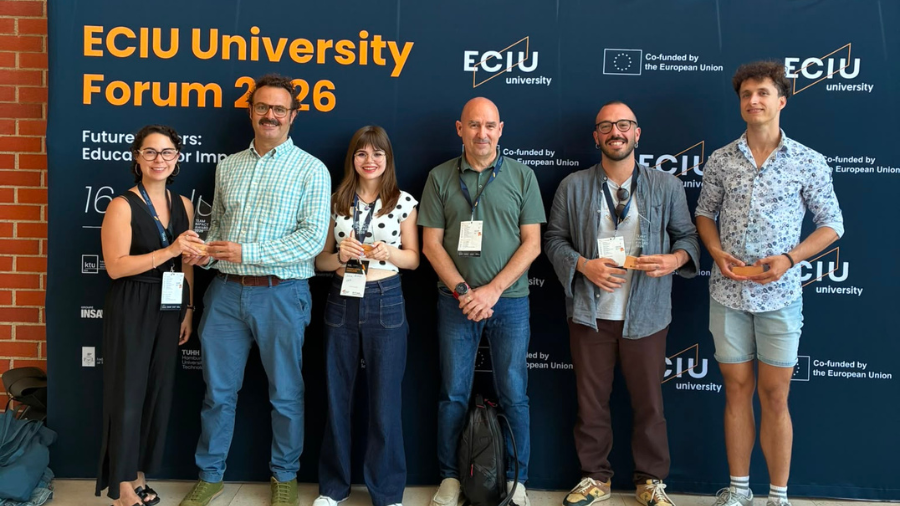
The ECIU, the UAB’s European alliance, held its annual forum on 16 and 17 June at the University of Aveiro, Portugal. The forum is a place for the communities of the member universities to meet and share ideas, experiences and co-create the future of education and innovation.
This year’s edition, entitled “Futuremakers: Educating for Impact”, focused on the role of education in generating a real impact in society. The meeting brought together some 300 participants, with active participation of the UAB community in several of the sessions.
UAB students were particularly active, giving presentations of their work and projects on social impacts and innovation. Mahamed Tawhid, enrolled in the Erasmus Mundus Master’s Degree in Interdisciplinary Mathematices, presented a paper on “Engineering Impact: How UN Energy Projects Can Fight Poverty, Climate Change, and Inequality”; Gracia del Pilar Sánchez, student of the bachelor’s degree in Genetics, presented “Futuremakers of Next-Gen Hospitals: Digital Avatars, Bioengineering and AI Medicine”; Andrés Palomo, student of the same degree, presented “From Student to Futuremaker: Using AI and Data for Real-World Impact”; and Paula Ignoto, student of the bachelor’s degree in Psychology, presented “Listening to Care: A Success Case in Co-creating Pediatric Hospital Well-being via CBL”.
The UAB lecturers taking part in the forum presented their initiatives in the field of teaching innovation and challenge-based learning. Josep Suquet, from the Faculty of Law, explained a teaching model entitled “Improvising Inclusion: Jazz Methods for Transnational Challenge-Based Learning”, and Jèssica Pérez-Moreno, from the Faculty of Education, presented the results of the European project INCO-ECTE with a conference entitled “Elements of success in the design of micromodules in education”.
Moreover, Jordi Mas (Faculty of Biosciences), Ruth León (Faculty of Translation and Interpreting), and Andrea Calsamiglia (Faculty of Psychology) formed part of several panels on the use of artificial intelligence in education, student well-being, and innovative teaching methodologies.
Also worth highlighting was the participation of Sílvia Blanch, lecturer from the Faculty of Education and head of the ECIU University project work package dedicated to the training of teachers in challenge-based learning (CBL), who organised the workshop “Cafè LATTE CBL: How AI Facilitates the Challenge-Based Learning Process”. And Francesco Gallo, enrolled in the university master's degree in Humanities and Digital Heritage, participated in a Skills Training session on "Level Up: Transforming Traditional Education into Impactful Learning Quests".
UAB challenge recognised with the Team Impact Award
The challenge posed by the UAB in the subject Artificial Intelligence in Communication of the bachelor’s degree in Interactive Communication, coordinated by lecturers Òscar Coromina and Adriana Monroy, was honoured with the Team Impact Award. This award is given to teams that stand out for their collaboration, creativity and ability to develop solutions with real and sustainable impact within the ECIU ecosystem.
The award-winning challenge focused on the application of artificial intelligence to the analysis of images from the digitised collection of Guions de Ràdio Barcelona (1925–1953), a key documentary resource for studying the beginnings of radio broadcasting in Spain, in collaboration with the Communication Library and the General Newspaper Archives of the UAB.
The aim of the project has been to develop solutions that increase their value, accessibility and reuse. In this sense, two main lines of work were proposed: on the one hand, the detection of censorship marks in historical documents—such as stamps, annotations or handwritten amendments from the Franco era—often barely visible in digitisation processes; and, on the other hand, the creation of a semantic search system capable of interacting with the archive using natural language, both in text and images.
Thanks to this collaboration, students worked with real materials and developed a prototype based on computer vision that was capable of detecting, classifying, and interpreting these visual traces of repression. In doing so, they provided an answer to a challenge that researchers had tackled for years without finding a satisfactory solution.
The work was carried out collaboratively by UAB students and students from Germany (Hamburg University of Technology), France (INSA Toulouse), Finland (University of Tampere), Ireland (Dublin City University), Italy (University of Trento), Lithuania (Kaunas University of Technology), Poland (Łódź University of Technology), and Sweden (Linköping University).
The award was received by the coordinators of the challenge, Òscar Coromina and Adriana Monroy-Galindo; Rosa Cabezas, from the Communication Library and General Newspaper Archives of the UAB; and student representatives Lucía Rubio and Stefano Giuseppe, from the UAB, and Tom Hillbrunner, from the Hamburg University of Technology.
The UAB, with Sustainable Development Goals
 Quality education